

Culture-Free Inflammation
Cell Panel Assay
Introduction
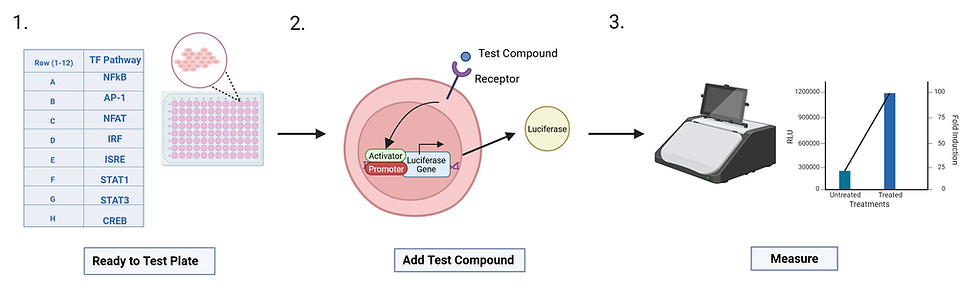
Signosis' Culture-Free Inflammation Cell Panel Assay is a ready-to-run 96-well assay plate pre-seeded with validated luciferase reporter stable cell lines targeting eight key inflammation-related transcription factor (TF) pathways: NFκB, NFAT, NRF2, AP-1, CREB, STAT1, STAT3, ISRE, and IRF.
Designed for inflammation profiling, immune modulation studies, and drug screening, this innovative platform eliminates the need for cell seeding or culture maintenance. Simply add your compounds directly to the wells and measure luciferase activity to gain fast, reproducible insights into inflammatory response, cytokine production, immune activation, and stress-related signaling.
Explore our full collection of transcription factor (TF) luciferase reporter stable cell lines, including those used in the panel and additional TFs available for individual purchase. These cryopreserved cell lines can be cultured using standard techniques, offering flexibility for custom assay development and mechanistic studies.
Custom configurations are also available to include other TFs of interest, providing a flexible and standardized solution for stress‑related drug discovery and mechanistic research.
Principle
The One-Step Inflammation & Immune Signaling Panel uses luciferase reporter stable cell lines to monitor the activation of nine transcription factor (TF) pathways involved in immune regulation and inflammatory signaling. Each reporter cell line contains a luciferase gene under the control of a TF-responsive element. When activated, the TF binds to its response element, inducing luciferase expression that is quantified as luminescence.
-
NFκB (Nuclear Factor Kappa B): Detects pro-inflammatory signaling pathways involved in cytokine production, immune response, and cell survival.
-
NFAT (Nuclear Factor of Activated T Cells): Monitors T-cell receptor–mediated transcription essential for immune cell activation and differentiation.
-
NRF2 (Nuclear Factor Erythroid 2–Related Factor 2): Reflects antioxidant defense and cellular protection mechanisms during inflammation and oxidative stress.
-
AP-1 (Activator Protein 1): Tracks stress- and cytokine-driven transcription linked to inflammation, proliferation, and immune response.
-
CREB (cAMP Response Element-Binding Protein): Reports on cAMP-related signaling involved in immune regulation and inflammatory mediator expression.
-
STAT1 (Signal Transducer and Activator of Transcription 1): Detects interferon-driven transcription important for antiviral immunity and inflammatory responses.
-
STAT3 (Signal Transducer and Activator of Transcription 3): Monitors cytokine and growth factor signaling associated with immune regulation and inflammation resolution.
-
ISRE (Interferon-Stimulated Response Element): Measures type I interferon response and antiviral gene activation.
-
IRF (Interferon Regulatory Factor): Reflects transcriptional activity of interferon regulatory proteins involved in antiviral defense and immune modulation.

Application
-
Profiling Toll-like receptor (TLR) signaling pathways to dissect innate immune responses and pathogen recognition mechanisms
-
Investigating cytokine storm dynamics and hyperinflammatory responses relevant to infectious diseases and sepsis
-
Studying the molecular and cellular mechanisms driving autoimmune diseases through dysregulated cytokine and TLR signaling
-
Screening and evaluating immunomodulatory drugs targeting cytokine production and TLR-mediated pathways
-
Biomarker discovery and therapeutic target identification for managing excessive inflammation and autoimmunity
-
Functional characterization of immune signaling cascades for vaccine adjuvant development and immune therapy optimization
Benefits
No Culture Required
Pre‑seeded with luciferase reporter cell lines, ready for immediate testing
Standardized & Reproducible
Consistent cell seeding and validation ensure reliable comparisons
Complete Reagent Package
Includes lysis buffer and luciferase substrate
Covers Eight Core Stress Pathways
Simultaneously analyze 8 key transcription factor (TF) pathways in a single 96-well format for efficient pathway screening.
Highly Sensitive & Quantitative
Direct correlation between TF activation and luminescence signal
Customizable
Option to include additional transcription factors relevant to your research
Fast, One‑Step Workflow
Add compounds and measure luminescence, reducing hands‑on time
Ideal for Multiple Applications
Perfect for antioxidant drug screening, toxicology, stress biology, and mechanistic studies