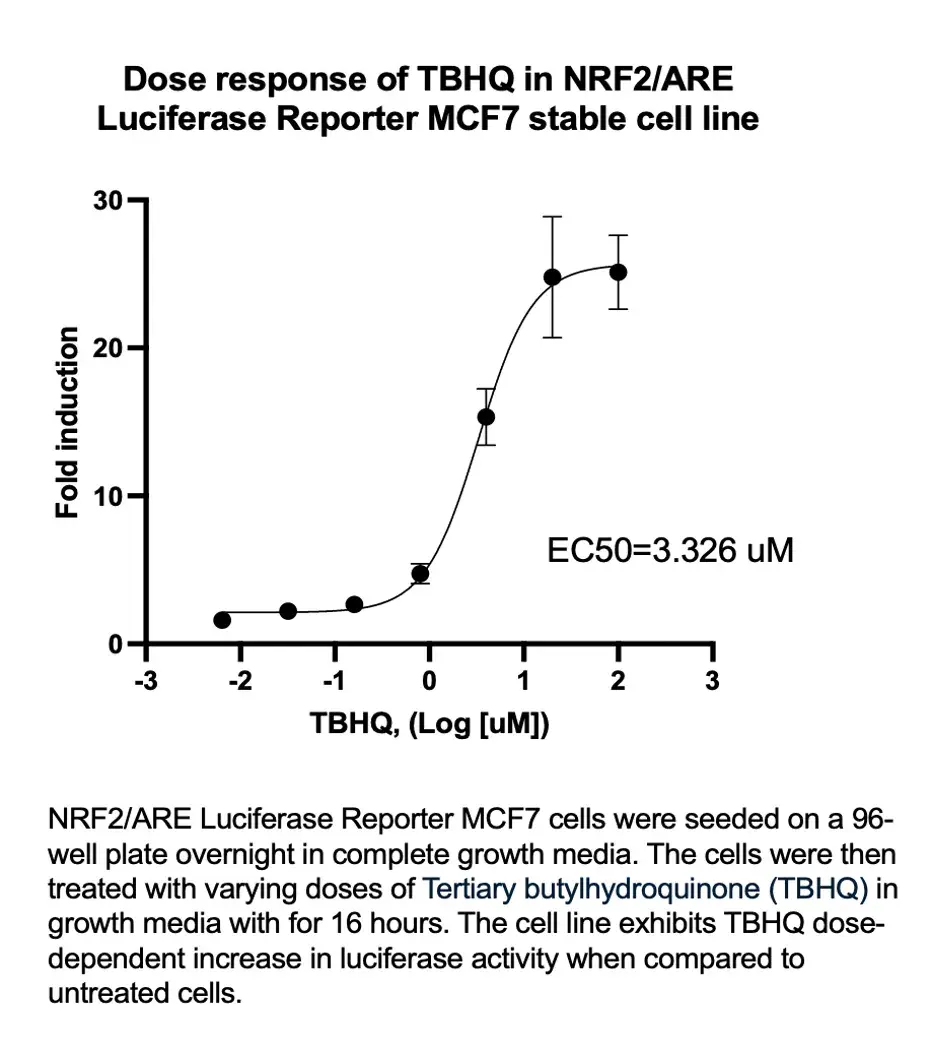
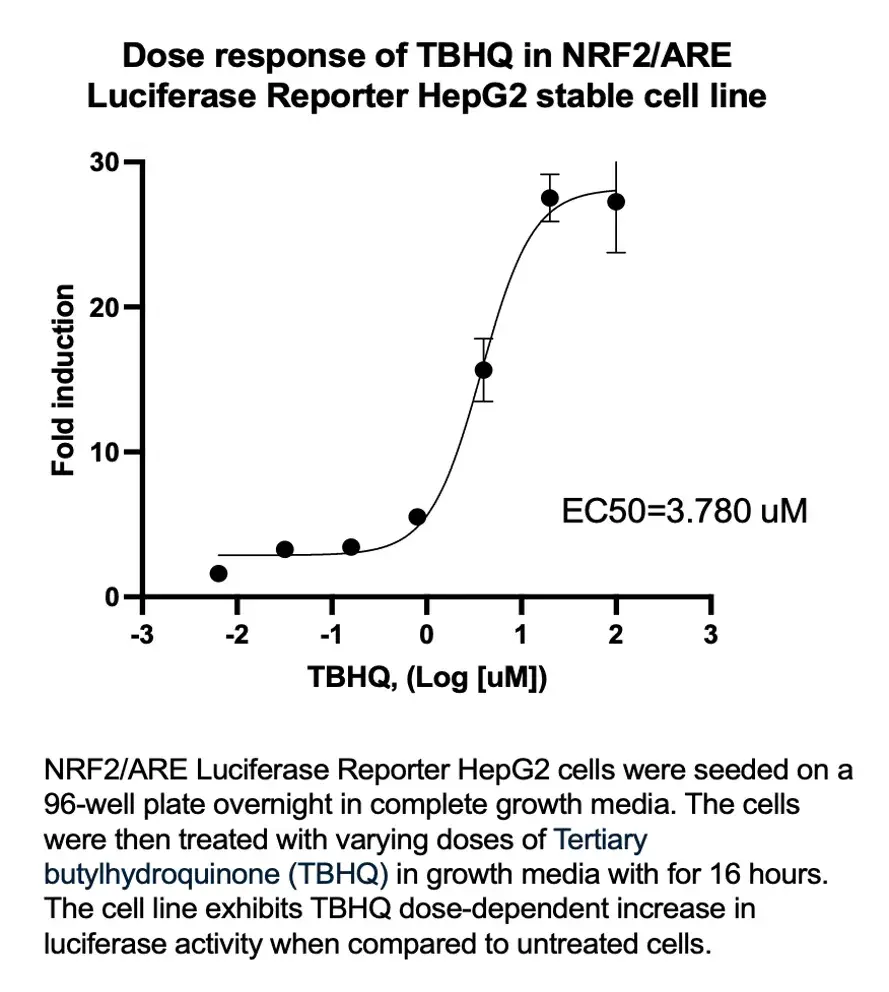
NRF2/ARE Responsive Luciferase Reporter HepG2 Cell Line is derived from Human Liver cancer, and stably express firefly luciferase reporter gene under the control of NRF2/ARE response element. This cell line is an ideal cellular model for monitoring the activation of Antioxidant response Pathway triggered by stimuli treatment, enforced gene expression and gene knockdown.
NRF2 plays a crucial role in cellular anti-oxidant defense, making it a therapeutic target for neurodegenerative diseases and cancer. Under normal conditions, NRF2 localizes in the cytosol and is rapidly degraded by the proteasome. Under oxidative stress, NRF2 is stabilized and translocates to the nucleus where it binds to a DNA promoter and initiates gene expression. In the nucleus, NRF2 forms a heterodimer with a small Maf protein and binds to the Antioxidant Response Element in the upstream promoter region of many antioxidative genes, and initiates their transcription.
This NRF2 luciferase reporter HepG2 stable cell line has been stably transfected with pTA-ARE-luciferase reporter vector, which contains 4 repeats of antioxidant response binding sites, a minimal promoter upstream of the firefly luciferase coding region, along with a hygromycin expression vector. Following selection, the hygromycin resistant clones were subsequently screened for TBHQ-induced luciferase activity. The clone with the highest fold induction was selected and expanded to produce this stable cell line.
Customer Q&As
Q: Is this reporter cell line suitable for high-throughput screening (HTS)?
A: Yes. The NRF2/ARE luciferase reporter cell line produces a strong and reproducible signal and is fully compatible with 96- and 384-well HTS formats.
Q: Does this reporter respond specifically to NRF2 activation rather than general stress?
A: Yes. The reporter is designed to respond primarily to NRF2 nuclear translocation and ARE binding. Functional validation is performed using known NRF2 activators to confirm pathway-specific induction.
Q: What is the recommended treatment time for NRF2 activation assays?
A: NRF2 activation is commonly detected after 16–24 hours of compound treatment, depending on the mechanism of action of the test compound.
Q: Is the cell line compatible with co-treatment or combination studies?
A: Yes. The stable reporter system is compatible with co-treatment, time-course, and combination compound studies.
Q: Does serum concentration affect NRF2 reporter activation?
A: Serum conditions can influence basal NRF2 activity. Assay recommendations include optimized serum concentrations to minimize background and maximize induction.
Q: Can this cell line be used for environmental or chemical safety screening?
A: Yes. NRF2/ARE reporter assays are widely used for toxicity, oxidative stress, and environmental chemical screening, and this cell line is suitable for those applications.
NRF2/ARE Luciferase Reporter HepG2 Stable Cell Line (2 vials)
- Shamim, K., Burnett, G. C., Zhang, J., Ahmed, N. H., Khan, S. I., Chittiboyina, A. G., Khan, I. A., Marshall, G. D., Bates, J. T., & Pugh, N. D. (2026). Evaluation of Andrographis paniculata in a mouse model of influenza A viral infection using oral administration and a translationally relevant dose. Frontiers in Pharmacology, 17, 1749384. https://doi.org/10.3389/fphar.2026.1749384
- Skoll, K., Zobl, M., Heiss, E., Braunboeck, B., Meerkatz, S., Radner, F., Castonguay, S., Holzner, M., Zbiral, A., Wirth, M., & Anzengruber, M. (2026). A novel 3D-printed tool for in vitro cell interaction studies under flow conditions. Lab on a Chip, 26, 3528–3545. https://doi.org/10.1039/d6lc00033a
- Marney, L. C., Choi, J., Alenicheva, V., Cabey, K., Beck, T., Milner, E., Gray, N. E., Soumyanath, A., Maier, C. S., Stevens, J. F., & Brown, K. S. (2026). CERES: Cluster-enabled regression of extract signatures for discovery of NRF2 activators in Centella asiatica by ion-mobility mass spectrometry, k-medoids clustering and ensemble Lasso regression. PLOS ONE, 21, e0354664. https://doi.org/10.1371/journal.pone.0354664
- Grosskopf, A., Kuru-Schors, M., Schmidt, S., Dienel, J., Höhn, A., Raupbach, J., Wächter, K., Köhler, C., Grune, T., Szabó, G., & Simm, A. (2025). Bread crust extract is a novel activator of aryl hydrocarbon receptor and modulator of NRF2 and NFκB in HepG2 and HCT 116 cells. Current Research in Food Science, 11, 10114 https://doi.org/10.1016/j.crfs.2025.101144
- Braunböck-Müller, B., & Heiß, E. (2025). Impact of cell culture conditions on NRF2 (nuclear factor E2 p45-related factor 2)-driven reporter gene expression. Advances in Redox Research, 16, 100136. https://doi.org/10.1016/j.arres.202100136
- Chae, H.-S., Ahmed, N. H., Dale, O. R., Avula, B., Khan, I. A., & Khan, S. I. (2025). Damiana (Turnera diffusa) reduces adipocyte cell differentiation and ameliorates myocyte glucose uptake. Journal of Dietary Supplements, 22(3), 401–41 https://doi.org/10.1080/19390211.2025.2480582
- Korczak, M., Redl, M., Roszkowski, P., Granica, S., Rollinger, J. M., Heiss, E., & Piwowarski, J. P. (2025). Synthesis, characterization, and anti-inflammatory potential of serotonin- and dopamine-conjugates of urolithin A. Biomedicine & Pharmacotherapy, 189, 118282. https://doi.org/10.1016/j.biopha.2025.118282
- Marney LC, Choi J, Alenicheva V, Cabey K, Beck T, et al. (2026) CERES: Cluster‑enabled regression of extract signatures for discovery of NRF2 activators in Centella asiatica by ion-mobility mass spectrometry, k-medoids clustering and ensemble Lasso regression. PLOS ONE 21(8): e0354664. https://doi.org/10.1371/journal.pone.0354664
- Shamim KS, Burnett GC, Zhang JZ, Ahmed NH, Khan SI, Chittiboyina AG, Ikhlas AK, Marshall GD, Bates JT, Pugh ND (2026). Evaluation of Andrographis paniculata in a mouse model of influenza A viral infection using oral administration and a translationally relevant dose. Frontiers in Pharmacology, 17:1749384. https://doi.org/10.3389/fphar.2026.1749384
- Grosskopf, A., Kuru-Schors, M., Schmidt, S., Dienel, J., Höhn, A., Raupbach, J., Wächter, K., Köhler, C., Grune, T., Szabó, G., & Simm, A. (2025). Bread crust extract is a novel activator of aryl hydrocarbon receptor and modulator of NRF2 and NFκB in HepG2 and HCT 116 cells. Current Research in Food Science, 11, 101144. https://doi.org/1016/j.crfs.2025.101144
- Korczak, M., Redl, M., Roszkowski, P., Granica, S., Rollinger, J. M., Heiss, E., & Piwowarski, J. P. (2025). Synthesis, characterization, and anti-inflammatory potential of serotonin- and dopamine-conjugates of urolithin A. Biomedicine & Pharmacotherapy, 189, 118282. https://doi.org/10.1016/j.biopha.2025.118282.
- Braunböck-Müller, B., & Heiss, E. H. (2025). Impact of cell culture conditions on NRF2 (nuclear factor E2 p45-related factor 2)-driven reporter gene expression. Advances in Redox Research, 16, 100136. https://doi.org/10.1016/j.arres.2025.100136.
- Ciro Cannavacciuolo, Cerulli, A., Dirsch, V. M., Heiss, E. H., Masullo, M., & Piacente, S. (2023). LC-MS- and 1H NMR-Based Metabolomics to Highlight the Impact of Extraction Solvents on Chemical Profile and Antioxidant Activity of Daikon Sprouts (Raphanus sativus L.). Antioxidants, 12(8), 1542–1542. https://doi.org/10.3390/antiox12081542
- Pan, P.-H., Wang, Y.-Y., Lin, S.-Y., Liao, S.-L., Chen, Y.-F., Huang, W.-C., Chen, C.-J., & Chen, W.-Y. (2022). Plumbagin ameliorates bile duct ligation-induced cholestatic liver injury in rats. Biomedicine & Pharmacotherapy, 151, 113133–113133. https://doi.org/10.1016/j.biopha.2022.113133
- Oskarsson, A., Rosenmai, A. K., Mandava, G., Johannisson, A., Holmes, A., Tröger, R., & Lundqvist, J. (2021). Assessment of source and treated water quality in seven drinking water treatment plants by in vitro bioassays – Oxidative stress and antiandrogenic effects after artificial infiltration. Science of the Total Environment, 758, 144001. https://doi.org/10.1016/j.scitotenv.2020.144001
- Johan Lundqvist, Andersson, A., Anders Johannisson, Lavonen, E., Mandava, G., Henrik Kylin, Bastviken, D., & Agneta Oskarsson. (2019). Innovative drinking water treatment techniques reduce the disinfection-induced oxidative stress and genotoxic activity. Water Research, 155, 182–192. https://doi.org/10.1016/j.watres.2019.02.052